This beginner – focused swim workout page introduces foundational swimming routines and tips to build comfort, technique, and confidence in the water, guiding new swimmers through essential skills and structured workouts.
You’ve decided to take up swimming as a good exercise and you want to start swimming workouts for beginners. This article is intended for the beginning swimmer who wants to use swimming as a primary fitness activity. At any swim pool with lanes for lap swimmers, you find a variety of swim styles and skill levels, many of whom started with swim workouts for beginners to build confidence and endurance. As you continue to swim, you will progress through these skill levels.
Here’s the best news about swimming at a pool. Everyone is there for the same thing. And once you slip into the water, you’re part of a new, but informal club. We swimmers don’t judge others, because once upon a time, we too were beginner swimmers. Welcome!
Benefits of Fitness Swimming
Few exercises are as safe and beneficial as swimming for fitness. Gentle on the body, the chance of injury is minimal. Many swimmers I know plan to swim for exercise for the rest of their lives, because you can*. The whole environment is flotation. You decide how hard and how long you want to exercise. Maybe you want a little cardio, maybe you want to work on your flexibility. Maybe a friend has been telling you how great swimming laps can be. And that friend is correct.
*I sometimes teach at a private pool, where there’s a 92-year-old man who swims laps for about 40 minutes.
Best Swim Workouts for Beginners
Beginner Swim Workout 1: Finding a Suitable Location
If you live in a warmer climate, you can probably find a year-round public pool that includes lap swim hours. Up north, we have a lot of clubs and municipal pools open in the summer. There are YMCA pools, high schools pools, and pools at many health clubs. If you are looking online for a place, the best search term to find a place to swim is “lap swim pools near me.” There are, of course, lakes, rivers, and quarries to swim in. Just be sure that it is suitable for your skill level and that you have at least one partner to swim with. In Britain there is a whole culture around outdoor swimming, called Wild Swimming.
Beginner Swim Workout 2: Pool Environments and Etiquette
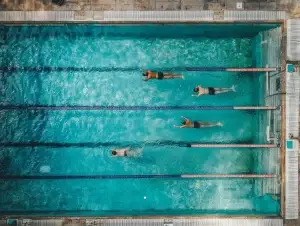
Most swimming pools have common elements, you’ll quickly become familiar with as you begin swim workouts for beginners. Plastic lane lines or ropes with floaties separate the pool into several lanes. On the bottom, centered in the lane lines is a dark line. There is usually a t-shape at the end, telling the swimmer that the wall is near. In the U.S., pools are usually 25 yards in length, while some outdoor pools are 50 meters long (called long course). In other countries, short course pools are 25 meters.
If you’re lucky enough to have a lane to yourself for our swim workout, great. But when the pool gets busy, you will need to share a lane with another swimmer. You’ll need to communicate with the other swimmer about which sides you’ll both take, using the lane line and the black line on the bottom to determine your half. Swim teams use a “circle swim” pattern so more than two people can use a lane. However, all swimmers should be able to swim at the same speed.
Before you get started, let your lane mate know your intentions. Never just jump and assume the other swimmer is aware of you. Sometimes one of you might swim a little off course and you might bump into each other. Experienced swimmers understand this and don’t mind.
But, if you are continuously swimming off course and interrupting your lane mate, that is bad form that you need to fix. Reddit has a great swimming channel, https://www.reddit.com/r/Swimming/, to go for helpful tips on managing yourself at the pool. Many discussions cover lane etiquette (which can vary from location to location).
Most pools have lifeguards. Their responsibility is to observe the pool (or a section) and be ready in an emergency. While you can ask questions, be aware that they need to watch the pool, and may not look at you as you talk. Often there is another guard on standby or on a break. If you have a question that requires elaboration, seek out one of the secondary life guards who can give you their undivided attention. If you are unsure about the pool rules (written and unwritten), ask questions.
Beginner Swim Workout 3: Facing your Fears
While I mention that swimming is a relatively safe activity, there is one major factor to consider–you can’t breathe in the water.Masterful swimming enables you to move your body while you breathe regularly, but this takes some learning. As an instructor, I often observe mild panicking in new swimmers. To manage this–and it will take time–learn become comfortable in the water.
Your first step is to learn how to regulate your breathing in a standing position and bob up and down. Using outstretched hands in the water, push up to bring your head underwater. Exhale with your face under the surface, then rise up and inhale. Repeat this several times. It is best to exhale through your nose to prevent water from going into your nose. You start to get used to your face being the water. If you have googles, get used to wearing them now.
Think of a beach ball full of air floating on the surface. Your lungs are air filled, which enables you to float at the surface. But your lungs are at the top half of your body, and your legs may be prone to sinking. Your goal is to learn to float on your back with your face out of water, breathing comfortably. If you have a teacher, they may help support your floating, but you can do this on your own.
Stand up with our arms outstretched and gently fall backwards. In a shallow end of the pool, your feet may still be on the bottom, but your face is out of the water. You can kick a little to raise your feet. Now you’re floating.
I encourage my beginners when floating with minimal movement (just a little kicking) to relax. “Be one with the water,” I say. Not only floating on your back good for relaxation, learning to float without touching the bottom is an important deep water survival tool.
Your first few sessions should consist of bobbing and floating. Until you learn to relax in the water, going forward with a struggle. Next steps are push off the wall, face down and glide. Be sure to exhale in the water and turn your head or stand up to get a breath.
Beginner Swim Workout 4: Beginning to Swim Laps
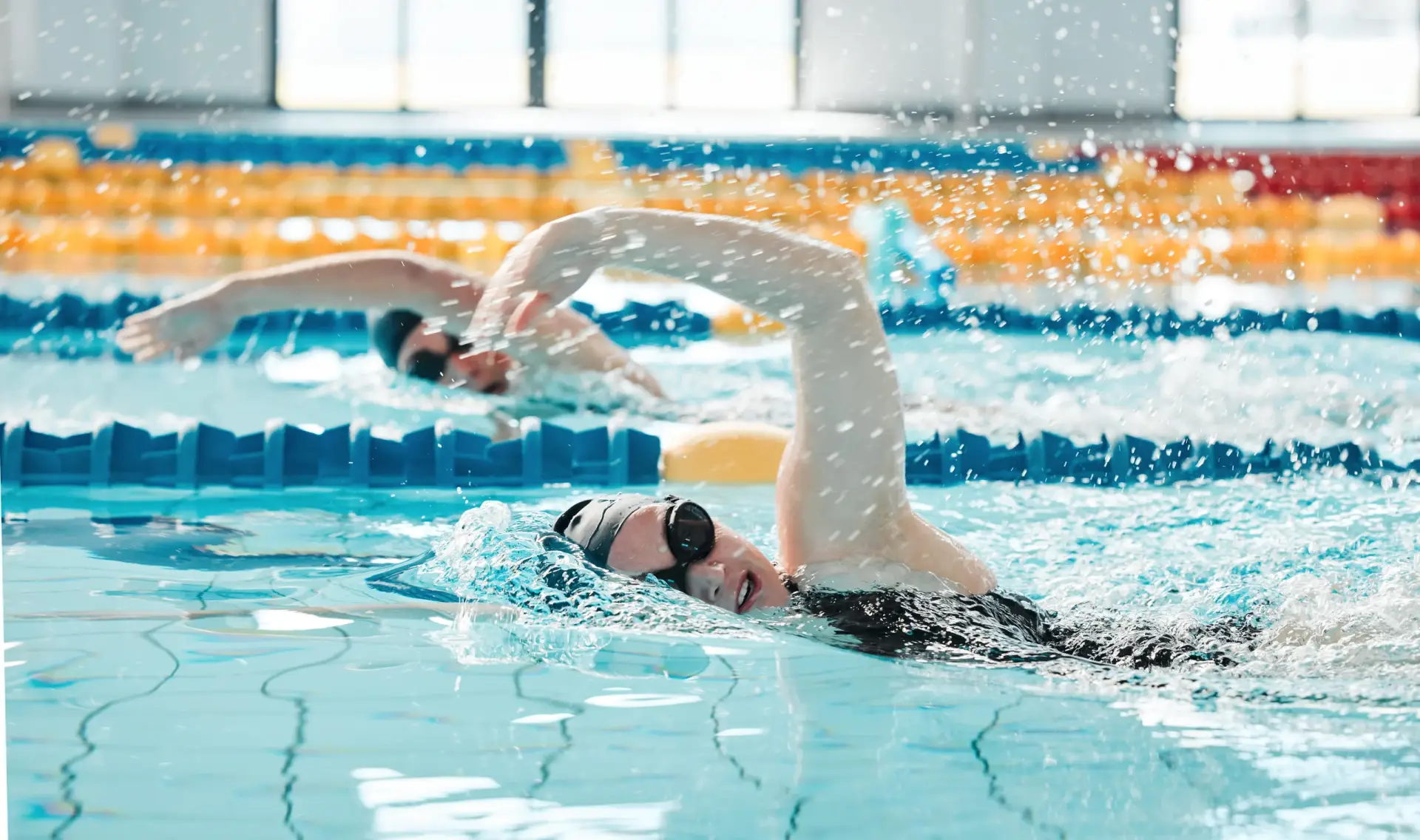
Now it’s time to work on actual swimming so that you can move from one end of the pool to the other end without struggle. Your next step is to master kicking. Not only does it keep your legs from sinking, you legs support your torso, and your torso supports your upper body.
Grab a kickboard. Keep your legs straight and point your toes while you kick. At first you might go slow, but the only way to improve is to continue working at it. Soon enough you will develop a good kicking flow that supports the rest of your front crawl stroke.
Now that you can move through the water, here are the steps for becoming a competent lap swimmer:
- Breathing Technique:Exhale continuously while your face is in the water and lift your chin/mouth only to inhale.
- Body Position:Keep your head down and look at the pool floor to maintain a horizontal, streamlined position.
- Easy Strokes:Start with freestyle (front crawl) or breaststroke to get comfortable moving through the water.
- Safety First:Learn in shallow water where you can stand, and consider professional lessons for proper technique.
- Progression:Start by swimming 25 yards, taking a rest, and repeating 4–8 times. Gradually increase reps over 4 weeks.
I tell swimmers, “Nobody gets better sitting on the couch thinking about it.” There may be days when you feel like a champion and others where you are frustrated. Don’t give up. It will get better. The more you swim, the more you swim!
Tools and Aids
- Kickboard: Supports your upper body while you work on kicking. As you get started, about 25 to 50 percent of your time should be with a kickboard. Hold the board with your hands about two thirds of the way up, with our arms resting on the board. At first, work on kicking face down for body position.
- Pull Buoy:Supports your legs when you’re not kicking. This enables you to focus on your arms and helps build strength. Many swim workouts include kicking and pulling for a well-rounded stroke.
- Training Fins:Are great for supporting you as you develop skills. While using a Pull Buoy might slow you down, fins help you go fast and help maintain good body positioning while you develop an efficient stroke.
- Monosnorkle:Eliminates breathing so that you can focus on an even, well-balanced stroke. A snorkel is useful for many swimming drills like sculling and Doggie Scoop.
- Finis Alignment Board:Is a one-handed kickboard. I use it a lot in my teaching. It enables swimmers to visualize a good streamlined stroke, body rotation and a proper head turn for breathing.
Avoid dependency. It’s easy to rely on any of these tools too much. They can mask deficiencies that you need to master. If you use them in a workout, be sure to also swim without them.
Ready. Set. Go.
Becoming a better swimmer is an iterative process. Even when you become a competent lap swimmer, you always give yourself feedback. Improving in increments small and large as you progress with swim workouts for beginners. But the two most important skills for a beginning swimmer are comfort and patience. If you find yourself losing either, take a step back. Swim a little slower, or find another stroke.
There are hundreds of resources online for swimming, including my Better Swimming Packages. However, as you get started, the best teacher is yourself. Finding useful YouTube videos can be a chore. Many are good videos and others provide poor instruction and bad advice. Most pools have teaching staff, who can provide lessons or a little advice if you ask.
You might want to join a Masters group. Coaches cater to all levels of swimmers, and many invite beginners to start workouts tailored to your skill level. While my Better Freestyle Package progresses through the learning process to develop a good freestyle, one of best places to find good workouts is through the US Masters Swimming website. It includes Best Workouts for Beginner Swimming. Other workouts require membership.