
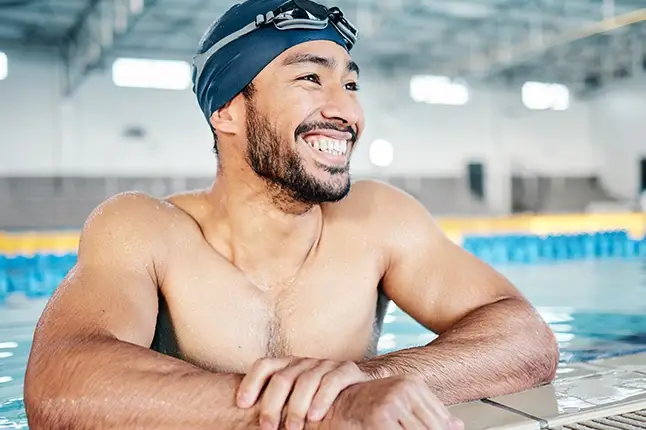
Swimming is a highly technical endurance sport. Unlike running or cycling, where power leads, swimming demands efficiency to move through water, nearly 800 times denser than air. Constant resistance means minor flaws can waste speed and energy.
Learning how to become a better swimmer is about perfecting techniques, training with intention, and practicing consistently. When these parts work together, swimming seems smoother and far less exhausting.
1. Learning the Fundamentals of Technique
You can’t build a fast house on a weak foundation. In swimming, your foundation has three key pillars. Without them, extra effort leads to inefficiency.
Body Position
A flat, streamlined body is the most important skill in swimming. If your legs sink, drag rises sharply, like swimming with a parachute. This slows you and stresses your upper body.
To improve, practice balancing on your side. If you sink, don’t fight it; use a pull buoy or noodle to feel the correct horizontal position, and fins to help your kick lift your legs. Aim for a parallel body line with a neutral, downward head.
Breathing
Many swimmers hold their breath, which can cause tension and fatigue. Instead, exhale constantly underwater. Practice bobbing at the pool edge, submerging, blowing bubbles, and inhaling as you emerge. In freestyle, rotate so your body creates an air pocket; breathe without lifting your head. Breathing has to feel natural and rhythmic.
Kicking
Efficient kicks start at the hips, with relaxed knees and flexible ankles. Keep your flutter kick: a fast, small movement up and down, narrow and steady, within your foot box, the imaginary rectangular space your legs move in just below your hips. Avoid wide, splashy kicks; these waste energy and create excess drag (resistance).
Practice kicking on your side, holding a kickboard (a small float for supporting your arms) to improve core engagement and body roll. A good kick stabilizes your body and keeps you moving forward.
2. A Smart Training Approach
Understanding how to become a better swimmer means learning how to train with purpose. Every workout should have a clear objective.
Swimming more frequently, in shorter sessions, is far more effective than occasional long swims. Four 30‑minute sessions per week will produce better results than one exhausting two‑hour workout. Frequent exposure reinforces motor patterns and creates an enduring feel for the water.
Drill Work Is Essential
Drills are specific exercises used to correct technique flaws and build muscle memory. Think of them as practice swings that make your full stroke more effective. Even 10–15 minutes of focused drill work per session will significantly improve your efficiency and speed over time.
Common examples include the Pulling Water drill, which helps you feel the catch (the initial phase where your hand grabs the water), and the Fist Drill. By swimming with clenched fists, you are forced to use your forearms for propulsion, heightening your awareness of how to push against the water.
My 5-Step Drill Progression for a Better Freestyle Stroke
To build a powerful and balanced freestyle, follow this specific progression. If you are just starting out, using training fins can help you maintain body position while focusing on these movements.
Side Kicking (The Foundation)
Start by kicking on your side with one arm extended forward and the other resting on your leg. Focus on keeping a long, streamlined body. When you need air, simply turn your face to the side out of the water.
The Exhale and Rotation
Once comfortable on your side, practice the breathing rhythm. Look downward into the water to exhale, then rotate your head on its axis—keeping your “bottom” ear in the water—to take a breath. Rotate your shoulders just enough to clear your mouth from the surface, then return to the downward position to exhale again.
The Straight Arm Drill
This drill builds balance and timing. While kicking on your side (6 kicks), lift your recovering arm straight up toward the ceiling. Pause for a moment to find your balance point, then let the arm fall forward into the water as your torso rotates, extending the opposite arm forward.
The Broken Arrow Drill
This is an evolution of the Straight Arm Drill. As your arm reaches the vertical “pointing” position, bend your elbow and point your hand toward the entry point. Focus on a clean entry sequence: fingertips, wrist, elbow, then shoulder.
The 6-1-6 Drill
This brings everything together. Kick on your side for six beats, then begin a full recovery stroke. As the trailing hand moves forward to meet the leading hand, rotate your head to breathe. Complete six more kicks on the opposite side and repeat the cycle.
Build Variety into Your Training
A swimming improvement plan should use varied training styles.
- Endurance sets are used to build aerobic capacity
- Pace work to develop consistency and awareness
- Sprint sets to build power and speed
Example weekly structure:
- Monday: Technique and drill focus
- Wednesday: Main set of 8 × 100 yards at a strong pace
- Friday: Longer continuous swim for endurance
This variety prevents stagnation and develops all energy systems.
Mental Focus Matters
Swimming can feel isolating, and tough sets demand mental strength.
Stay engaged by:
- Counting strokes or laps
- Focusing on breathing rhythm
- Setting minor goals for each repeat
Visualization is also powerful. Picture smooth, controlled strokes and relaxed breathing before and during workouts. Mental presence helps you push through discomfort while continuing the technique.
3. Practical Workout Tips You Can Use Today
Apply these simple but powerful strategies in your next swim.
Use Training Tools Wisely
- Fins help improve body position and kick mechanics
- Snorkels allow focus on stroke mechanics free of breathing disruption
- Pull buoys support leg position and reinforce proper alignment
Count Your Strokes
Track strokes per length and aim to reduce them at the same speed. Fewer strokes usually mean better efficiency.
Practice Your Turns
Flip turns (rotating underwater to push off the wall headfirst), or open turns (touching the wall with your hand, then pushing off with your feet), act like free speed. They help preserve momentum, reset your breathing, and save time. Practice these turns during warm‑ups or cool‑downs until they feel automatic.
Consistency Is the Real Secret
Becoming a better swimmer is a process, and this progress comes from repeating good habits, refining techniques, and trusting steady effort over time. Small improvements accumulate; one lap at a time.
At Swim Faster Madison, we specialize in breaking complex swimming skills into simple, effective steps. Whether you’re a beginner, building confidence or an experienced swimmer chasing faster times, organized guidance makes improvement inevitable.
One Reply to